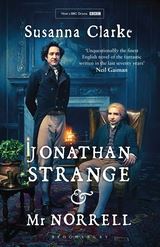
Writing Fantasy Workshop with Helen Hagemann @ the Fremantle Arts Centre, Friday, 13th May, 1pm-3pm.This workshop will look at the ten major writing tips for writing Fantasy. Writers will read an excerpt from Susanna Clarke's Fantasy novel Jonathan Strange & Mr Norrell (also a BBC TV series), and will be given two writing exercises with prompts.
Venue: Fremantle Arts Centre, Room 2
Time: 1-3pm What to bring: Notepad, pen, laptop or ipad
Cost: OOTA $20 - NON-OOTA $25 (ask for membership form to save). Please note:New attendees who arrive without the class fee will be asked to leave.
Jonathan Strange & Mr Norrell BBC Trailer
- See more at: http://www.bloomsbury.com/uk/jonathan-strange-and-mr-norrell-9781408856888/#sthash.m3RuKvoK.dpuf
MAJOR SEVEN-PART BBC TV SERIES. OVER 1 MILLION COPIES SOLD
Two magicians shall appear in England. The first shall fear me; the
second shall long to behold me ...
The year is 1806. England is beleaguered by the long war with Napoleon, and
centuries have passed since practical magicians faded into the nation's past.
But scholars of this glorious history discover that one remains: the reclusive
Mr Norrell whose displays of magic send a thrill through the country.
Proceeding to London, he raises a beautiful woman from the dead and summons an
army of ghostly ships to terrify the French. Yet the cautious, fussy Norrell is
challenged by the emergence of another magician: the brilliant novice Jonathan
Strange. Young, handsome and daring, Strange is the very opposite of Norrell.
So begins a dangerous battle between these two great men which overwhelms the
one between England and France. And their own obsessions and secret dabblings
with the dark arts are going to cause more trouble than they can imagine.
Reviews
“Unquestionably the finest English novel of the fantastic
written in the last seventy years. It's funny, moving, scary, otherworldly,
practical and magical ... Closing Jonathan Strange & Mr Norrell after
800 pages my only regret was that it wasn't twice the length” – Neil Gaiman
“The language of the book is such a pleasure you'd probably want to go and
read it anyway” – Lauren Laverne, BBC
Radio 6
“Best novel I've ever read” – Richard
Madeley
“'An elegant and witty historical fantasy which deserves to be judged on its
own (considerable) merit'” – Sunday
Telegraph
“'Full of spells, bad weather, statues that talk, haunted ballrooms and
sinister gentlemen with thistledown hair ... be enchanted! *****'” –
Elle
“'A nourishing, 19th-century-style novel that will warm readers through any
number of dark and stormy nights ... Clarke makes her magical story
ridiculously engrossing'” – Daily
Telegraph
“'This is, in both the precise and the colloquial sense, a fabulous book ...
a highly original and compelling work'” – Sunday Times
“I read it years ago and loved it … They've preserved the scale and majesty
of the story … So you have credible, fully imagined characters recognisably of
the same world we inhabit” – Bertie
Carvel
“I read the book and loved it. It sort of obsessed me for a while and I felt
an affinity with what turned out to be my character, Vinculus. I found the
footnotes addictive! If there wasn't one on the next page I would be
disappointed” – Paul Kaye
Jonathan Strange & Mr Norrell BBC Trailer
- See more at: http://www.bloomsbury.com/uk/jonathan-strange-and-mr-norrell-9781408856888/#sthash.m3RuKvoK.dpuf
Prose Workshop: Facts in Fiction and Non-Fiction with Helen Hagemann @ the Fremantle Arts Centre, Friday, 29th April 1pm-3pm.This workshop will look at the ways to include "facts" in your fiction or non-fiction. The
class will read excerpts on various points of view by Melissa Donovan, Emma Darwin, Roy Clark and Geoff Dyer of the Guardian. Writers will be able to apply these ideas in 2-3 writing exercises. Venue: Fremantle Arts Centre, Room 2,Time: 1-3pm
Cost: OOTA $20 - NON-OOTA $25 (ask for membership form to save).
Including Facts in Fiction and Non-Fiction
Fiction is neither real nor unreal but a world existing between
places of factual certainty and the avenues of an author’s imagination.
The first thing you need to know about writing fiction, whatever the
genre, is that you must get your facts right. Those titbits of
information lend fiction its authenticity, so it’s essential that you do
them justice. A reader will only believe a lie for as long as it holds some truth, and those truths have to be accurate.
But how do you do it? How do you take the everyday and draw a new existence from it? How do you write fiction based on facts?
You need two tools at your command before you begin: experience (personal, professional, or both) and the ability to research.
Armed with these, you can then pick any number of methods from the
following list to make your fiction come alive in a reader’s hands.
Critiquing Workshop with Helen Hagemann @ the Fremantle Arts Centre, Friday, 15th April 11.00am - 12.45pm.
This workshop will be held in the FAC Cafe (small room) due to the
non-availability of our usual writing room. Since we are a little put
out this week, the best option is a chance to do some critiquing.
WHAT YOU NEED TO KNOW
Writers are asked to bring along up to 4 pages of their work in Times
New Roman, 12, 1.5 spacing (+ extra copies for our eyes). This can be
either a short story, part of your novel, your memoir, or part of a
non-fiction work that you are having difficulty with. We will critique
for an hour, followed by rewriting that section on the day. Please note: Our critiquing group will still meet at 10.00am and run for one hour, followed by class. Members also have the chance to send 8 pages, or just bring on the day. Note also: You
will need to "fully charge" ipads and laptops as there are no
power-points available. Beginners who do not have a project on the go,
are very welcome to join us. Many thanks, Helen
Prose Workshop: The Author is Three-In-One: Learning how to distance the author from narrator and character with Helen Hagemann @ the Fremantle Arts Centre, Friday, 1st April, 1pm-3pm.
Class to read part of Frederick Reiken's essay titled The
Author-Narrator-Character Merge from the anthology A Kite in the Wind. As well, writers will have the opportunity to write different POV versions (exercises) using the idea of psychic distance of the author from narrator and character. Please Note: Class will be conducted in Room 2 (the old large room) upstairs at the Fremantle Arts Centre. This workshop acknowledges two authors, Julie Proudfoot and Megan Ward who alerted me to the book A Kite in the Wind and within its pages a valuable essay titled, The
Author-Narrator-Character Merge: Why Many First-Time Novelists Wind Up with
Flat, Uninteresting Protagonists by Frederick Reiken.
Prose Workshop: Writing a Synopsis with Helen Hagemann @ the Fremantle Arts Centre, Friday, 18th March 1pm-3pm.
This workshop is a response to members of the class asking for a guide to writing a synopsis. Class to read various examples and texts as well as writers will be given the opportunity to write several versions of a synopsis eg. 200, 300 or 500 words of their current novel or future novel in progress. Beginners who are not writing a novel will be given alternative exercises.
Prose Workshop: Meta Fiction with Helen Hagemann @ the Fremantle Arts Centre, Friday, 4th March 1pm-3pm.This workshop will look at the elements
that make a work meta-fictional incl. the many variations. The class will read excerpts from meta-fiction by Debra Adelaide (The Women's Pages) and Thea Astley (Drylands). Writers will be given a long list of works to discover this genre for themselves, as well as 2-3 writing exercises.
Venue: Fremantle Arts Centre, Room 3
Time: 1-3pm
Cost: OOTA $20 - NON-OOTA $25 (ask for membership form to save).
What is Meta Fiction?
Meta-fiction
refers to fictional works that draw attention to the fact that they are a work
of fiction.
Metafiction is a literary device
used self-consciously and systematically to draw attention to a work's
status as an artefact. It poses questions about the relationship between
fiction and reality, usually using irony and self-reflection. It can be compared to presentational theatre,
which does not let the audience forget it is viewing a play;
metafiction forces readers to be aware that they are reading a fictional
work.
A guide to understanding meta-fiction.
A story about a writer who creates a story
A story that features itself (as a
narrative or as a physical object) as its own prop or MacGuffin
A story containing another work of fiction
within itself
A story addressing the specific conventions
of story, such as title, character conventions,
paragraphing or plots
A novel where the narrator intentionally
exposes him or herself as the author of the story
A book in which the book itself seeks
interaction with the reader
A story in which the readers of the story
itself force the author to change the story
Narrative footnotes, which continue the
story while commenting on it
A story in which the characters are aware
that they are in a story
A story in which the characters make
reference to the author or his previous work
Prose Workshop: Fast Fiction Friday with Helen Hagemann @ the Fremantle Arts Centre, Friday, 19th February 1pm-3pm.
This workshop is a 'Guide to Outlining and Writing a Novel in 30 Days'. Class to read various examples and texts as well as writers will be given the ways and means to start a novel.
National Novel Writing Month (often shortened to NaNoWriMo, "na-noh-RY-moh"),[2] is an annual, Internet-based creative writing
project that takes place during the month of November. NaNoWriMo
challenges participants to write 50,000 words (the minimum number of
words for a novel) from November 1 until the deadline at 11:59PM on
November 30. The goal of NaNoWriMo is to get people writing and keep
them motivated throughout the process. The website provides participants
with tips for writer's block,
local places writers participating in NaNoWriMo are meeting, and an
online community of support. The idea is to focus on completion instead
of perfection. NaNoWriMo focuses on the length of a work rather than the
quality, encouraging writers to finish their first draft so that it can
later be edited at the author's discretion.[3] NaNoWriMo's main goal is to encourage creativity worldwide.[4]
The project started in July 1999 with 21 participants, but by the 2010
event, over 200,000 people took part and wrote a total of over 2.8
billion words.[5]
Writers wishing to participate first register on the project's
website, where they can post profiles and information about their
novels, including synopses and excerpts. Word counts are validated on
the site, with writers submitting a copy of their novel for automatic
counting. Municipal leaders and regional forums help connect local
writers, holding writing events and providing encouragement.
Prose Workshop: Writing "Flashes" with Helen Hagemann @ the Fremantle Arts Centre, Friday, 5th February 1pm-3pm. This is a refresher start for the year. We will be writing short stories of no more than 100 words. Exercises will also give writers the chance to practice short prose of 33 words. Class to read various examples of this fiction, from 100WordStory.org, Mike Jackson and others. Writers will have the opportunity to be published on Writing at the Centre's website and also will be informed about other markets for this genre.
Flash fiction captures the essence of a story. In a snapshot, the
subject is usually in front. The background takes a seat behind your
conscious mind. You know it's there, but you are focused on the
subject.
Example: Picture a child catching a bright, red ball. what do you
see? Action. What's the background? I didn't tell you, but you
probably saw a flash of one. Your own experiences detailed the sentence
for you. Maybe you saw the child outside since that's where balls are
usually thrown. Maybe you saw a young child because the ball is bright
red. Older children play with basketballs, footballs or
baseballs--usually none of these are red. Did you see sunshine? Was
that why the ball was bright? Did you see grass and trees? Or did you
see city streets and buildings? That would depend on your perception of
outside and ball playing, wouldn't it?
Make your words Work
Use strong, active verbs and few if any linking verbs and adjectives.
There is no time in flash fiction for a lot of description or detail
or for much characterization. The writer must depend upon the readers'
experiences to fill in the gaps. Dialogue-driven stories are great for
quick action, character and conflict development.
Writing flash fiction is an excellent exercise to tighten your
writing--to pack as much action in as few words as possible. You can
use flash fiction as the core idea to develop longer pieces--even
novels. It helps identify the four elements of fiction: Setting,
Character, Conflict and Resolution.
One-word sentences can work for you. They get attention,
convey meaning with their punctuation and say whole paragraphs in just
one word. They are great hooks.
MORE ABOUT FLASHES
Here's some great advice from this year's Bridport Prize (UK) Judge David Gaffney about writing flash/short-short stories.
1: Does it have a beating heart?
A good short-short story should have a strong idea at
its core, and you should be able to feel this idea beating away
underneath every sentence. You may not be able to see it, or be able to
explain what it is; but if it's a good story, you will know it is there.
2: Is it too cold or too hot?
A healthy short-short story can be flaming hot with
desire, or cold, distant and awkward to handle; what matters is
consistency. A story which is chilly and standoffish most of the way
through and then suddenly pulls you up with a volcanic reveal at the end
can be disconcerting and ultimately unconvincing. Temperature
variations need to managed carefully and dramatic changes for which the
reader hasn't been adequately prepared should be avoided. A punchline
ending which yanks you out of the story world can destroy your belief in
what you have read so far - like falling into an icy pool after you've
been bathing in the sun.
3: Do its eyes follow you about the room?
A good short-short story is aware of you reading it. It
never turns its back on its audience. It is in the room with you at all
times. So no tricks of POV, flashbacks or show-pony foot work. If you
push the short-short story it pushes back. The story should feel real.
It shouldn't smell of wiki-research. Every change of gear will have been
earned and will feel as if it was the only thing that could have
happened in those circumstances. You are watching the story and the
story is watching you. Because with the short-short story you have
created something real with a life of its own.
4: Is it breathing?
A healthy short-short story will expel puffs of air from
an aperture somewhere in its centre. Long, powerful bursts. This is the
first sign that the story might be a real living thing. But breathing
can be faked. So apply the following tests. Does the story hold your
interest with every line? Short-short fiction allows the language no
rest, and every word has to pay its way. Are there regular points of
interest in the choice of language and in the concepts introduced by the
story? We need to know at all times that the story is breathing, the
story is alive. That someone who knows what they are doing is in
control. So don't make a zombie story. Make your story alive and real.
Avoid worn-out tropes, cliches, stereotypes and previously-loved ideas.
Not all call centres are boring, not all environmentalists are good, not
all old people are nice, not all council workers are jobsworths, not
all artists are worthwhile, and not all chain shops are evil.
5: Can it hear you?
While reading a good story you will have questions. You should
have questions. Where is the action happening? Who is talking? Why are
they telling me this? And why are they telling me it now? Ask these
questions of the story and if it cannot answer, call the nurses.
6: Is the pressure too low?
Sometimes a short-short story is just too low-drain. It
demands too little of the reader and of the writer. A pleasant vignette,
a neat collection of words that describes a moment with no sense of
urgency or jeopardy. If this is the case, class A drugs or adrenaline
shots may be required.
7: Is everything intact?
Count the extremities and check that all essential parts
are there. If everything seems to be there, but it feels as though
something is missing, that's a good thing.
Good short-short fiction will have a sense that
something has been removed, a vital part amputated. The teller of the
story knows something that the reader doesn't. We can sense a presence,
humming from within the story like a distant generator, haunting us like
the pain from a phantom limb.
Helen
Hagemann
has poetry and prose published in Australian literary magazines,
including Southerly, Overland, Westerly and Cordite. In 2004, Hagemann
won an Australian Society of Authors Mentorship
program studying with NSW poet, Jean Kent. In 2008, she won a Varuna
Macquarie/Longlines poetry publishing scholarship spending one week at
Varuna with Editor Ron Pretty. Her collection Evangelyne & Other Poems was then published
by the Australian Poetry Centre's New Poet Series, Melbourne (2009). Her second collection of Arc & Shadow was published by
Sunline Press, Cottesloe WA, (2013). Hagemann holds a BA in Writing and a Masters in Writing from Edith Cowan University, and has taught at the Fremantle Arts Centre for nine years. Currently, she is working on her third novel (The Last Asbestos Town) and a collection of poetry for children, titled Miniscule.
Poetry Tutor
Shane McCauley is an award-winning poet with seven collections, including The Chinese Feast, Deep Sea Diver, The Butterfly Man, Shadow Behind the Heart, Glassmaker (Sunline Press 2005)
The Drunken Elk (Sunline 2010) & Ghost Catcher. His latest collection is tRICKSTER, published by Walleah Press (2015). He co-edited WA poetry, The Weighing of the Heart, also published by Sunline in 2007. He has taught English at Edith Cowan University, and has taught poetry at the Fremantle Arts Centre since twelve years. He has also received local and overseas Fellowships.


 May 08, 2016