Sunday, 24 January 2016


Prose Workshop: Writing "Flashes" with Helen Hagemann @ the Fremantle Arts Centre, Friday, 5th February 1pm-3pm.  This is a refresher start for the year. We will be writing short stories of no more than 100 words. Exercises will also give writers the chance to practice short prose of 33 words. Class to read various examples of this fiction, from 100WordStory.org, Mike Jackson and others. Writers will have the opportunity to be published on Writing at the Centre's website and also will be informed about other markets for this genre.


Flash fiction captures the essence of a story. In a snapshot, the subject is usually in front. The background takes a seat behind your conscious mind. You know it's there, but you are focused on the subject.
Example: Picture a child catching a bright, red ball. what do you see? Action. What's the background? I didn't tell you, but you probably saw a flash of one. Your own experiences detailed the sentence for you. Maybe you saw the child outside since that's where balls are usually thrown. Maybe you saw a young child because the ball is bright red. Older children play with basketballs, footballs or baseballs--usually none of these are red. Did you see sunshine? Was that why the ball was bright? Did you see grass and trees? Or did you see city streets and buildings? That would depend on your perception of outside and ball playing, wouldn't it?

Make your words Work

Use strong, active verbs and few if any linking verbs and adjectives. There is no time in flash fiction for a lot of description or detail or for much characterization. The writer must depend upon the readers' experiences to fill in the gaps. Dialogue-driven stories are great for quick action, character and conflict development.
Writing flash fiction is an excellent exercise to tighten your writing--to pack as much action in as few words as possible. You can use flash fiction as the core idea to develop longer pieces--even novels. It helps identify the four elements of fiction: Setting, Character, Conflict and Resolution.
One-word sentences can work for you. They get attention, convey meaning with their punctuation and say whole paragraphs in just one word. They are great hooks.

MORE ABOUT FLASHES
Here's some great advice from this year's Bridport Prize (UK) Judge David Gaffney about writing flash/short-short stories.

1: Does it have a beating heart?

A good short-short story should have a strong idea at its core, and you should be able to feel this idea beating away underneath every sentence. You may not be able to see it, or be able to explain what it is; but if it's a good story, you will know it is there.

2: Is it too cold or too hot?

A healthy short-short story can be flaming hot with desire, or cold, distant and awkward to handle; what matters is consistency. A story which is chilly and standoffish most of the way through and then suddenly pulls you up with a volcanic reveal at the end can be disconcerting and ultimately unconvincing. Temperature variations need to managed carefully and dramatic changes for which the reader hasn't been adequately prepared should be avoided. A punchline ending which yanks you out of the story world can destroy your belief in what you have read so far - like falling into an icy pool after you've been bathing in the sun.  

3: Do its eyes follow you about the room?

A good short-short story is aware of you reading it.  It never turns its back on its audience. It is in the room with you at all times. So no tricks of POV, flashbacks or show-pony foot work. If you push the short-short story it pushes back. The story should feel real. It shouldn't smell of wiki-research. Every change of gear will have been earned and will feel as if it was the only thing that could have happened in those circumstances. You are watching the story and the story is watching you. Because with the short-short story you have created something real with a life of its own. 

4: Is it breathing?

A healthy short-short story will expel puffs of air from an aperture somewhere in its centre. Long, powerful bursts. This is the first sign that the story might be a real living thing. But breathing can be faked. So apply the following tests. Does the story hold your interest with every line?  Short-short fiction allows the language no rest, and every word has to pay its way. Are there regular points of interest in the choice of language and in the concepts introduced by the story? We need to know at all times that the story is breathing, the story is alive. That someone who knows what they are doing is in control.  So don't make a zombie story. Make your story alive and real. Avoid worn-out tropes, cliches, stereotypes and previously-loved ideas. Not all call centres are boring, not all environmentalists are good, not all old people are nice, not all council workers are jobsworths, not all artists are worthwhile, and not all chain shops are evil.

5: Can it hear you?

While reading a good story you will have questions. You should have questions. Where is the action happening? Who is talking? Why are they telling me this? And why are they telling me it now? Ask these questions of the story and if it cannot answer, call the nurses.

6: Is the pressure too low?

Sometimes a short-short story is just too low-drain. It demands too little of the reader and of the writer. A pleasant vignette, a neat collection of words that describes a moment with no sense of urgency or jeopardy. If this is the case, class A drugs or adrenaline shots may be required.

7:  Is everything intact?

Count the extremities and check that all essential parts are there. If everything seems to be there, but it feels as though something is missing, that's a good thing.
Good short-short fiction will have a sense that something has been removed, a vital part amputated. The teller of the story knows something that the reader doesn't. We can sense a presence, humming from within the story like a distant generator, haunting us like the pain from a phantom limb.

Thursday, 14 January 2016

Prose Tutor
Helen Hagemann has poetry and prose published in Australian literary magazines, including Southerly, Overland, Westerly and Cordite. In 2004, Hagemann won an Australian Society of Authors Mentorship program studying with NSW poet, Jean Kent. In 2008, she won a Varuna Macquarie/Longlines poetry publishing scholarship spending one week at Varuna with Editor Ron Pretty. Her collection Evangelyne & Other Poems was then published by the Australian Poetry Centre's New Poet Series, Melbourne (2009). Her second collection of Arc & Shadow was published by Sunline Press, Cottesloe WA, (2013). 
Hagemann holds a BA in Writing and a Masters in Writing from Edith Cowan University, and has taught at the Fremantle Arts Centre for nine years. Currently, she is working on her third novel (The Last Asbestos Town) and a collection of poetry for children, titled Miniscule. 


Poetry Tutor


Shane McCauley  is an award-winning poet with seven collections, including The Chinese Feast, Deep Sea Diver, The Butterfly Man, Shadow Behind the Heart, Glassmaker (Sunline Press 2005) The Drunken Elk (Sunline 2010) & Ghost Catcher. His latest collection is tRICKSTER, published by Walleah Press (2015). He co-edited WA poetry, The Weighing of the Heart, also published by Sunline in 2007. He has taught English at Edith Cowan University, and has taught poetry at the Fremantle Arts Centre since twelve years. He has also received local and overseas Fellowships.


Why not join Shane McCauley and Helen Hagemann for some writing in 2016. Download this year's brochure for more information.  http://members.iinet.net.au/~helen.hagemann/WACBrochure16.pdf

Saturday, 19 December 2015


CLASS TIMETABLE

FRIDAYS AT THE FREMANTLE ARTS CENTRE FOR 2016
JANUARY
Poetry Fri 15th, 1pm-3pm with Shane McCauley
NO PROSE CLASS on Friday, 22/1/2016
Poetry Fri 29th, 1pm-3pm with Shane McCauley

FEBRUARY
Prose Fri 5th, 1pm-3pm with Helen Hagemann - Start of Prose year
Poetry Fri 12th, 1pm-3pm with Shane McCauley
Prose Fri 19th, 1pm-3pm with Helen Hagemann
Poetry Fri 26th, 1pm-3pm with Shane McCauley

All Friday classes are held in Room 3 of the Fremantle Arts Centre,
1 Finnerty Street, Fremantle
Cost $20 OOTA, $25 Non-OOTA
Classes are casual with no booking required.

Sunday, 6 December 2015


Final Prose Class for the Year with Helen Hagemann on Friday, 11th December @ 1pm. We will have some popular writing exercises and in the second hour of the workshop "READINGS OFYOUR WORK" - Please bring along your favourite piece to read for approximately 5 - 8 minutes. This is very good practice, especially in lieu of OOTA's 2016, 20 year anniversary plans.

Saturday, 21 November 2015


Summer holidays and travel are peeking at us through the porthole windows. It's time to think about walking along a Bali beach or trekking the scenic walks of Vietnam. Perhaps you're spending Christmas with the rellies on the Gold Coast or further north towards the Great Barrier Reef. No matter where you are headed, as a writer, you might want to record your amazing travels. Remember, the internet is immortal, so why not open up a travel blog or Facebook travel page where you can upload your pics and tell the world about some of the amazing places you've been to. While you're here check out this excellent travel blog TheAdventuresOfDr 
Workshop: Travel Writing: keeping a journal, blog or facebook travel page. Friday, 27th November 1.00pm-3.00pm
Venue:  Fremantle Arts Centre, Room 3, Upstairs, North Wing
Cost:  $20 OOTA - $25 NON-OOTA


Sunday, 8 November 2015

Prose Workshop: Writing Crime with Helen Hagemann @ the Fremantle Arts Centre, Friday 13th November 1pm-3pm. Class to read an extract from The Ultimate Writing Coach including a section called Why not Turn to Crime by Simon Brett. Exercises will be on writing crime scenes and discussion will revolve around police procedure.
Venue:  Room 3, Upstairs, North Wing
Cost:  $20 OOTA - $25 NON-OOTA

Writing Crime Scenes by Garry Rodgers
  •  The mechanism of death. We die because our central nervous system gets unplugged and that can happen in a number of ways. Mental and physical death are two different things. Garry also has a spiritual belief that the spark of humanity in us lives on after death, based on what he has experienced. People are quite hard to kill so the quick ways we kill in novels can be quite unrealistic. Shutting down the CNS requires force. Firearms and knives are the most common ways, but it is messy and not something that happens quickly.
  • On crime scenes. Writers often forget to use all five senses. Crime scenes are not pleasant and by evoking the senses, you can make this experience more real. Terminology is often used badly as well. Check what you write with experts. Also, get your basics right e.g. revolver vs pistol. A lot of acronyms are used at the crime scenes so include those.
  • On the emotional impact of the crime scene when you’re a professional vs a ‘rookie’. The coroner focuses on the cause of death, not on the fact that it happened. You have to try to establish who, what, when, where and by what means. First responders will have arrived before the investigators so the chaos of the scene will have dissipated somewhat. First responders can walk into danger if the factors that caused the death are still there.
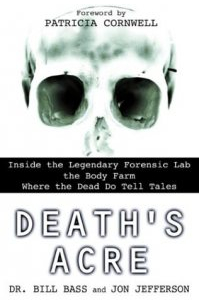
  • death acre bill bass body farmIn death, the body will change very quickly. [I mention the Body Farm, Death’s Acre by Bill Bass.] The biggest factor is temperature. The warmer the temperature, the larger the body, the faster the decomposition. The body temp will eventually reach equilibrium with the scene temp. Most indicative are mortis (change) in body; pallor (color) algor (temperature), rigor (stiffening), livor (pattern of blood settling) and decomp (breaking down of tissue). It’s nature’s recycling.
  • Time of death is critical to get right so the investigation can check the alibis of suspects, but it’s not just about the body. Bodies can be found days or weeks after the event, so the stage of decomposition should be compared to the scene itself. But other factors are also important e.g. cellphone records are crucial because so many people carry them. The history will show the last call made but also when calls are received and go unanswered. Also check when the person was last seen. If in the home, when is the post dated. It’s the overall pattern. It’s not just the pathologist pronouncing time of death. It is also approximate unless there is an eye witness.
  • The best way to get away with murder is to completely get rid of the body. The ocean is a good place and Garry mentions some mob hits where the bodies have been disposed of in nasty ways. But it is actually very hard to do. Plus most writers need a body to write the book around.
  • On dental records. It always seems coincidental that people get ID’ed so fast through dental records. Most dentists do have records but they are not kept centrally. You need to have an idea who the person is in order to narrow down where their records might be. When a person is reported missing, one of the things the police will do is obtain their dental records in case they are needed for identification later.
  • Using DNA. The science of genetic fingerprinting, which is now very sophisticated. In fact, so sophisticated it is hyper-sensitive and can be contaminated at the scene or during investigation. The maternal DNA can be used to identify a body against a list of potential suspects. There wouldn’t be a crime scene investigation today without DNA so it is critical to include.
  • How the body is identified. If the DNA or fingerprints don’t match anything, it can depend on the circumstances, but there are always unidentified bodies. The good old-fashioned detective work needs to be done in this case, for example, receipts found on the body or aspects found at the scene. Investigation is a multidisciplinary approach, pulling people from different teams.
  • Gender and homicide. Are there equal rights in the death business? Males are more violent than females. There has to be a strong motive for a woman to commit murder. Domestic violence is a common one. Knives are often used as they are handy at the moment of conflict. Planned and premeditated murders are rare, but women are more intelligent and might contract out the killing. So murder by women is likely to be violent and sudden or crafty and difficult to detect.
Reference: http://www.thecreativepenn.com/2012/07/22/writing-death-crime-scenes/

FINISHING AND SUBMITTING TIPS
(An Extract from The Ultimate Writing Coach)
Write something every day, even if it's only 10 words. If it's rubbish, you can change it later.
When the first draft is done, hide it for a month. Then go back and read it with a fresh eye.Proofread your work. Typos, spelling mistakes and clunky grammar will irritate your readers. Submit a neat manuscript, typed in double-spacing on one side of A4, with numbered pages and secure but loose binding (such as treasury tags). Include a polite and friendly covering note.  If you don't like the rules, break them. After all, it's your book. While I was waiting for the muse to descend, I'd forgotten the golden rule: practice makes it better.  Actually, I'm no great fan of golden rules (see tips box). But this one holds true. Writing is a craft like any other: you have to work at it. If the text is feeble, fix it. Those binned sheets of purple prose aren't signs of failure — they're a resource. Having grasped the uncomfortable fact that Becoming a Writer would involve hard graft, I was ready to start producing something with a beginning, a middle and — hallelujah! — an end [from Secrets of a Novelist by Nia Williams]

Sunday, 25 October 2015

Facts & Digressions in Fiction: Prose Workshop with Helen Hagemann, Friday 30th October. Class to read three extracts from Honey Brown's Red Queen. A writing exercise on "digression" and discussion will revolve around creating space for facts and digressions, esp. Brown's limited facts.

1.00pm - 3.00pm: Room 3, Upstairs, FAC North Wing
OOTA $20 - NON-OOTA $25

I Digress
For certain kinds of readers and writers, the best part of any book (often literary, though not always) is not a moment of supreme tension or complex gathering of plot strands. It’s an astute observation or unexpected description—some digressive phrase or passage that the writer seemed to pluck out of thin air. Yet when we sit down to write, we’re often overwhelmed with the practical necessities of motivation and plot and momentum and, as a result, find ourselves barreling down a straight line. The problem, we realise, is that we don’t know how to step off that line. [from Read to Write Stories]

Entering Story Facts or Events
Story events may take your character to a new physical locale or to a new psychological place. Red Queen is a psychological thriller, H.M. Brown (Honey Brown) and therefore steers us away from the biological facts of a deadly virus; the often touted "too much information." We know it is deadly in her portrayal of corpses and decaying bodies. 'I stepped down from the rock and onto the body of the man. He was on his back, his chest pushed up from something under him, his arms hanging either side, his legs twisted and caught in undergrowth.'
Reviews: The lack of details surrounding the virus itself and the lack of knowledge about how it came to be is hardly distracting as the reality of the situation through Shannon's eyes suggests that these are not details that should be expected to be known. 
"There is not so much focus on the Red Queen virus other than it is out there and is the reason for isolation and the danger that the introduction of an unknown person represents. Her descriptions of the Australian bush that surrounds the cabin are so clear that you can see, hear and sadly sometimes smell the action." [from Books and Musings from Downunder]


Honey Brown lives in country Victoria, Australia. She is the bestselling author of the critically acclaimed novels Red Queen (winner of the Aurealis Award), The Good Daughter (longlisted for the 2011 Miles Franklin Award), After the Darkness, Dark Horse (winner of the 2014 Davitt Award) and Through the Cracks (shortlisted for the 2015 Davitt Award).
Honey began writing novels in 2000. Before settling down she worked and lived in various remote places throughout Australia. She spent her childhood in Tasmania, growing up in a convict-built house. In her late-twenties she was involved in a farm accident, and now lives with the challenges of a spinal injury. Her most recent release, Six Degrees, a collection of erotic short stories, is available in bookstores now. She is currently working on her sixth psychological thriller.

Sunday, 11 October 2015

Dialogue and Dialogue Tags: Prose Workshop with Helen Hagemann @ the Fremantle Arts Centre, Friday 16th October 1pm-3pm.  Reading an extract from Tim Winton's Cloudstreet, together with writing exercises and discussions on the "setting out" of dialogue and dialogue tags. We will also look at Winton's unpunctuated dialogue.

Venue:  Room 3, Upstairs, North Wing
Cost:  $20 OOTA - $25 NON-OOTA

TIM WINTON was born in Perth in 1960. He has written many much-loved books for children and adults. His work is published in many countries and languages and his stories have been made into plays and films. Tim lives with his family by the sea in Western Australia, and often writes about the sea in his books. His is a patron of the Australian Marine Conservation Society and has campaigned to save Western Australia's Ningaloo Reef from development.
Dialogue and Choices of Speech Tags

(Extract) from Field of Words


The best dialogue doesn’t require attribution tags at all (not even ‘said’, as can be seen in Margaret Atwood’s dialogue-only story, There Was Once, or in Tim Winton’s, Cloudstreet; read an extract here.) because the characters are so well-drawn and the actions are so clear, the reader can distinguish the emotional context and delivery of the word. So what do you use instead of dialogue tags? Usually said/replied/asked, or their present tense equivalent. These tags ‘disappear’ from the dialogue because the reader is concentrating on what is said (that is, they’re focused on the story). This is not to say that we never use dialogue tags – sometimes they are necessary – what it does mean is that we use tags with intention.

(Extract) Don't be scared: dialogue without quotation marks by Richard Lea

Like many of the symbols habitually used to mount text on to the page, inverted commas have a long and complicated history. The impetus to standardise the use of quotation marks came from the "drive for realism" shown by authors such as Daniel Defoe, Henry Fielding and Samuel Richardson as they experimented with the newest form of literature, the novel. The 1748 edition of Clarissa separated speakers with "dashes or new lines", but sometimes placed an opening quotation mark "at the exact point at which a quotation began, with a new 'mark of silence', or closing quotation mark ("), accompanying it where the quotation ended".

By stripping away a couple of centuries of typographical convention,  Winton like Samuel Beckett and James Joyce doesn't just give us the characters' brief or accented speech, he also aligns himself with the kind of author who's been ignoring typographical convention all along.

Wednesday, 30 September 2015


NEW - Prose Critiquing Class to be held after Helen Hagemann's class each Friday fortnight. Commences this week, Friday, 2nd October at 3pm and will be convened by Robert Jeffreys. Jeffreys is a NIDA graduate and has been a professional actor, a Drama and English teacher, and has had two plays produced by Lyons Productions at The Blue Room, others at the Black Swan Theatre Company and the Perth Theatre Company. He has also written two dramas for ABC Radio, and is now concentrating on short fiction. Writers please note:  Please bring enough copies to hand around, maximum three pages of prose (any genre), typed in Times New Roman, 1.5 spacing.

Monday, 28 September 2015


Prose Workshop: Writing "Hooks" with Helen Hagemann @ the Fremantle Arts Centre, Friday 2nd October 1pm-3pm.  Class to read extracts of Prologues from The Casual Vacancy, The Secret River and Shallow Breath, together with writing exercises and discussions on Novel /Short Story/ Non-Fiction beginnings as "Hooks".


A Great Hook usually comes at the beginning of the work.
The hook is that tiny, important little bit of awe you have to plant in readers’ minds. This is not always planted in a first chapter, but authors often use a "prologue" to spark a reader's curiosity. With short stories it is usually the opening sentence, such as the opening lines in Edgar Allan Poe's The Fall of the House of Usher:

     During the whole of a dull, dark, and soundless day in the
     autumn of the year, when the clouds hung oppressively low in the
     heavens, I had been passing alone, on horseback, through a
     singularly dreary tract of country; and at length found myself,
     as the shades of the evening drew on, within view of the
     melancholy House of Usher.
 
The hook isn’t a singular entity. There’s not just one of them. There has to be many of them, and if your book starts with a Prologue as a hook, then continue the same somewhere close by; either in Chapter 1 as Rowling does, or at least within the first 5,000 words. If you wish to 'Set the Stage' Dickens's opening prologue in A Tale of Two Cities is a good example.

         It was the best of times, it was the worst of times, it was the age of wisdom, it was the age of 
         foolishness, it was the epoch of belief, it was the epoch of incredulity, it was the season of Light,
        it was the season of Darkness, it was the spring of hope, it was the winter of despair, we had 
        everything before us, we had nothing before us, we were all going direct to Heaven, we were all
        going direct the other way— in short, the period was so far like the present period, that some of 
        its noisiest authorities insisted on its being received, for good or for evil, in the superlative 
        degree of comparison only.

If you're writing memoir, non-fiction or biography, you can open the work with an "Introduction". An Introduction is usually for the following purposes:
•To talk about how you came to write the book, especially if that will help draw the reader into the book.
•To sell the book to the potential reader/​buyer (lure them, hook them, make them want to read more). In The Secret River, Grenville has William Thornhill thinking about a sentence of death in England perhaps being a far better fate than the harsh life/climate of the NSW penal colony.
•To answer the question: why this book? why now? why this person? why by this author?
•To talk about how you got the information — what main sources (and how they differ from other books on the subject, such as book #24 about Sir Donald Bradman, for example).

Obviously, this makes our work a lot harder, since we have to continue thinking of hooks to keep piquing our readers’ curiosity. However, the first hook we come up with doesn’t have to be monumental to keep the reader's attention. Rather, the first hook just has to interest them long enough to get them to the next hook, and perhaps when that particular question has been answered (or the information shown in the Prologue has made sense in the early part of the novel), then it will be that time when the reader is well on their way to discover the drama of the story. Of course, there are many kinds of hooks (ie. tension/ suspense/ problems/ obstacles/ or the inciting incident) in which case you've probably created a page turner. Alternating different characters' stories in chapters is also a great hook! You only have to read Larry Brown's Father and Son to see how that's done. Good luck!

Sunday, 13 September 2015


Prose Workshop with Helen Hagemann, Friday 18th September. Class to read three extracts of  "Free Indirect Speech" from James Joyce's A Portrait of the Artist as a Young Man, Virginia Woolf's short story Mrs Dalloway in Bond Street, and Ian McEwan's Atonement. Writing exercises and discussion will revolve around "free indirect speech" and other narrative modes.

1.00pm - 3.00pm: Room 3, Upstairs, FAC North Wing
OOTA $20 - NON-OOTA $25

Free indirect speech is a style of third-person narration which uses some of the characteristics of third-person along with the essence of first-person direct speech. (It is also referred to as free indirect discourse, free indirect style, or discours indirect libre in French.) Randall Stevenson suggests, however, that the term free indirect discourse "is perhaps best reserved for instances where words have actually been spoken aloud" and that cases "where a character's voice is probably the silent inward one of thought" should be described as free indirect style.

Saturday, 29 August 2015

  
by KayVee.INC | via Flickr
Friday 4th September the workshop is the final in the series “Plot & Development” is called “Writing the Character Outline”. The class will look at how outlining can bring out ‘voice’. The main topics will be 1. Character Arc,  2. Main Traits and 3. Details of your character(s).  1pm-3pm, Upstairs, Room 3 at Fremantle Arts Centre.  OOTA Member $20 - Non OOTA $25


Developing Characters by Lawrence Block

The chief reason for almost any reader to go on turning the pages of almost any novel is to find out what happens next. The reason the reader cares what happens next is because of the author’s skill at characterization. When the characters in a novel are sufficiently well drawn, and when they’ve been so constructed as to engage the reader’s capacities for sympathy and identification, he wants to see how their lives turn out and is deeply concerned that they turn out well.
   Some novels depend more on characterization than do others. In the novel of ideas, the characters often exist as mouthpieces for various philosophical positions; while the writer may have taken the trouble to describe them and give them diverse individual attributes, they often have little real life outside of their specific argumentative role in the novel.
   Some whodunits rely on the clever intricacy of their plotting to hold the reader’s attention, stinting on characterization in the process…..Agatha Christie supplied her Hercule Poirot with a variety of attitudes and pet expressions, but I’ve never found that the little Belgian added up to anything more than the sum of these quirks and phrases. He serves admirably as a vehicle for the solution of brilliant mystery puzzles but does not interest me much as a character….And while one of Ms. Christie’s Poirot mysteries will always do to fill an idle hour, I’m a passionate fan of her Jane Marple stories, not because their plots are appreciably different from the Poirots but because Marple herself is such a fascinating character, warm and human and alive.

References: Lawrence Block "On Writing" and Gabrielle Lessa - Article "How Outlining can bring out Voice".https://janefriedman.com/2015/08/24/how-outlining-can-bring-out-voice/?utm_content=buffer177ad

Sunday, 16 August 2015


Second workshop in the Series: Plot & Development with Helen Hagemann
Friday, 21st August 2015 1.00-3.00pm, Room 3, Fremantle Arts Centre.
Cost:  $20 OOTA   $25 NON-OOTA

This workshop "How to write an outline" includes writing a novel or short story outline of one of your favourite authors, and by utilising a template of Helen Hagemann's "3 Act outline" of her novel The Ozone Cafe. There will be an exercise on writing your own "outline", as well as class discussion on choice of genre, point of view, timeline, and choice of tense.


Outlining by Lawrence Block
An outline is a tool which a writer uses to simplify the task of writing a novel and to improve the ultimate quality of that novel by giving him/herself more of a grasp on its overall structure.
    And that’s about as specifically as one can define an outline, beyond adding that it’s almost invariably shorter than the book will turn out to be. What length it will run, what form it will take, how detailed it will be, and what sort of novel components it will or will not include, is and ought to be a wholly individual matter. Because the outline is prepared solely for the benefit of the writer himself, it quite properly varies from one author to another and from one novel to another. Some writers never use an outline. Others would be uncomfortable writing anything more ambitious than a shopping list without outlining it first. Some outlines, deemed very useful by their authors, run a scant page. Others, considered equally indispensable by their authors, run a hundred pages or more and include a detailed description of every scene that is going to take place in every chapter of the book. Neither of these extremes, nor any of the infinite gradations between the two poles, represents the right way to prepare an outline. There is no right way to do this – or, more correctly, there is no wrong way. Whatever works best for the particular writer on the particular book is demonstrably the right way.
 
The writer who does not use an outline says that to do so would gut the book of its spontaneity and would make the writing process itself a matter of filling in the blanks of a printed form. At the root of this school of thought is the argument first propounded, I believe, by science-fiction author Theodore Sturgeon. If the writer doesn’t know what’s going to happen next, he argued, the reader can’t possibly know what’s going to happen next.
   There’s logic in that argument, certainly, but I’m not sure it holds up. Just because a writer worked things out as he went along is no guarantee that the book he’s produced won’t be obvious and predictable. Conversely, the use of an extremely detailed outline does not preclude the possibility that the book will read as though it had been written effortlessly and spontaneously by a wholly freewheeling author.

POETRY CLASS TERMS 3-4, 2019

POETRY with Shane McCauley

JULY - DECEMBER
12th, Friday 1pm - early December 2019 1pm-3pm

Website - Now Archived

Twitter


Powered by Blogger.

Search This Blog

Literary news

Australian Children's Poetry
  • visit Poem of the Day

  • About Us

    My Photo
    Writing at the Centre is an independent writing class conducted each Friday at the Fremantle Arts Centre, Print Room, upstairs in the main building.

    PROSE CLASS TERMS 3-4, 2019

    Prose Classes with Chris Konrad
    Chris will work with you each Friday fortnight bringing with him his writing skills and expertise as a published writer and prize winner.
    Dates: Friday 28th June - early December 2019, 1pm - 3pm

    OOTA ANTHOLOGY 2019

    OOTA ANTHOLOGY 2019
    Theme: Place - Closing 31/3/2019

    Dorothy Hewett Exposed as a Miscreant

    Popular Posts